
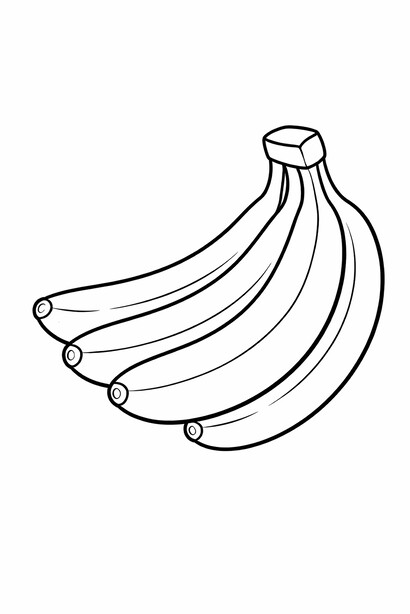
Banana: History & Fun Facts
Bananas were first domesticated in parts of Southeast Asia and New Guinea, where people cultivated them long before the fruit became common in Western markets. Over time, bananas spread across the Indian Ocean, Africa, the Caribbean, and Latin America, becoming one of the world's most widely traded fruits. Their curved shape made them instantly recognizable, and their growth pattern made them especially memorable. Bananas do not grow one by one on a typical store shelf pattern in nature. They grow in large hanging hands and bunches, which is why bunch-of-bananas pages feel more true to life than a drawing that shows only one fruit alone.
The bunch is the key clue on this page. A banana by itself is easy to recognize, but a full group attached together tells a more specific story about how the fruit is harvested and transported. That is why old produce ads, educational posters, and shipping art often showed several bananas gathered as one hanging cluster. The grouped form suggests tropical farming and market display at the same time. It also gives the page a more lively silhouette, with curves overlapping and pointing in different directions. In fruit illustration, bananas are one of the best examples of a subject whose natural arrangement matters as much as its individual shape.
Bananas became tied to shipping history as well as farming. In the late nineteenth and twentieth centuries, refrigerated transport and faster trade routes helped bananas move from tropical plantations to distant grocery stores in huge numbers. That made them one of the most familiar fruits in school lunches, kitchens, and household fruit bowls. Their popularity helped fix a standard image in people's minds: a bright bunch with a shared stem at the top. Even on a simple coloring page without color, that form still suggests markets, tropical farms, and produce stands. The page feels familiar because banana history is also a story about global trade and everyday food.
Bananas are unusual because the plant is technically a giant herb, not a true tree. What looks like a trunk is really a pseudostem made from tightly wrapped leaf bases, and the plant can grow very tall before the fruit cluster forms. After one stem fruits, that stem does not keep producing forever in the same way a normal tree branch might. New shoots, often called pups, take over the next cycle. Dessert bananas, plantains, and regional cooking bananas all belong to a wider family of similar plants, which means the banana world includes much more than the common supermarket type most people picture first.
Bananas are widely grown in warm tropical and subtropical regions, especially in parts of Latin America, Africa, and Asia. They are common, but large-scale banana farming also faces serious challenges from plant disease, weather, and the fact that many export bananas are genetically very similar to one another. A healthy banana plant can grow quickly, and in favorable climates fruit may be harvested within about a year after planting, though conditions matter a lot. Because banana bunches are heavy and dramatic, growers often support plants or manage spacing carefully. That combination of fast growth and fragile farming conditions makes bananas both familiar and surprisingly demanding crops.
More Fruit Coloring Pages
How to Use This Worksheet
Download this free printable coloring page or print instantly. Great for kids, preschool, and classroom activities.
This banana page uses a bunch instead of a single fruit, matching how bananas are usually seen in real life.
Frequently Asked Questions
Is this banana coloring page free?
Yes. This fruit coloring page is free to print or download for personal and classroom use.
Is this coloring page free to download and print?
Yes, completely free. Every coloring sheet on PrintColoringSheet.com is free for personal and non-commercial classroom use. No sign-in, no subscription, and no watermarks — just click Download or Print and you're ready to color.